Who does what in a Shopify subscription
A subscription on Shopify has two halves, and they belong to different people.
The app's half. A subscription app — Shopify's own Shopify Subscriptions is free on its App Store listing (read 20 October 2026) — creates the plans ("Every 2 weeks, 10% off"), charges the card on each renewal, and gives your customers a page to pause, skip or cancel. Shopify calls each plan a selling plan and keeps it on the product.
The theme's half. Showing those plans on the product page, beside the price, and sending the one the shopper picked along with the product into the cart. That is this block. It does not create a plan or bill anybody, and no theme can: a plan only exists once an app has made it.
Knowing the split saves money. Subscription apps usually sell a product-page widget as part of the plan; the widget is the theme's half, and a theme that does it already leaves the app to do what only it can.
Subscribe or buy once, priced where the choice is
The block shows one-time purchase and the subscription side by side. The plans of a group sit together as one card — its name, its price and a row of delivery choices — so "every 2 weeks" and "every 4 weeks" are one tap apart.
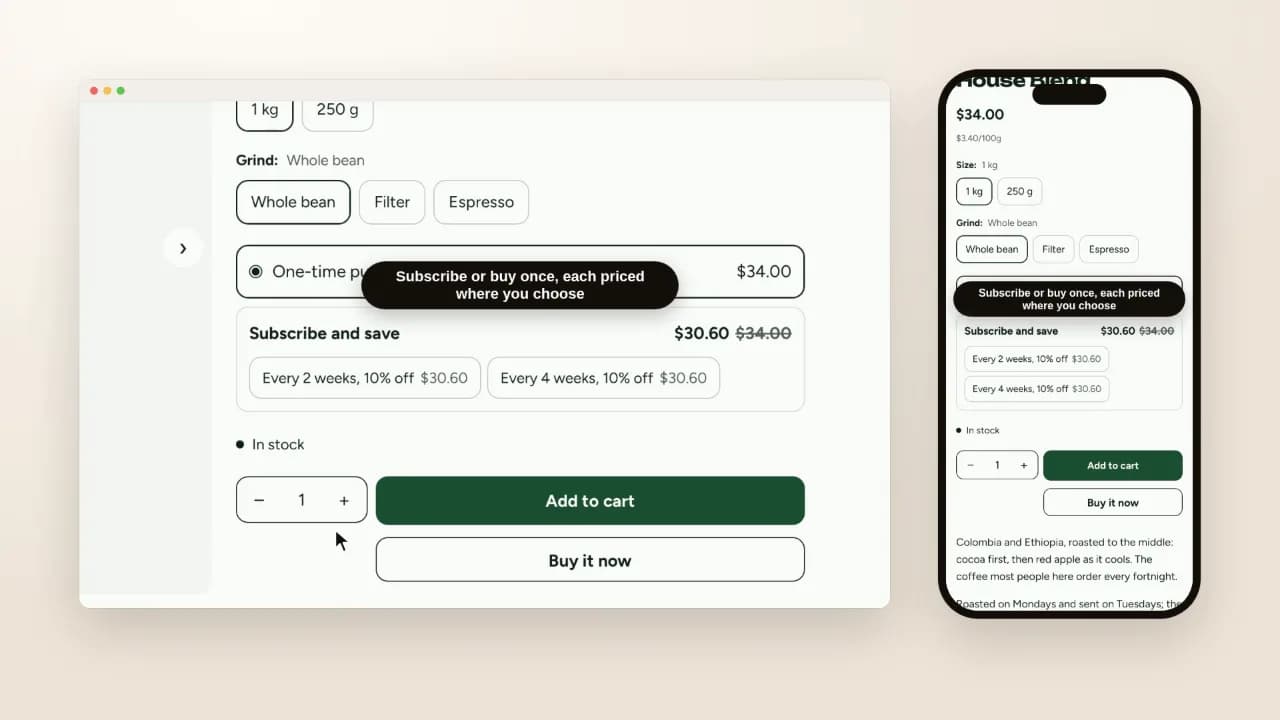
Each option carries its own price. The one-time price sits beside one-time, the plan's price beside the plan, with the regular price struck through when the plan saves money. The main price at the top of the page does not change while the shopper compares; the comparison is where the decision is.
Two details that matter on a real catalogue:
- Plans can differ by variant. A 1 kg bag may be on a plan the 250 g bag is not, at a different price. The block follows the variant the shopper picked.
- Subscription-only products have no one-time option. Shopify marks them as requiring a plan, and offering a one-time purchase anyway would send an order the checkout refuses.
A sold-out variant shows its plans but cannot be subscribed to until it is back.
No script on the buying path
The choices are part of the product form itself, so the plan reaches the cart in the same request as the variant and the quantity — with JavaScript or without it. On a product with no plans the block renders nothing at all; there is no empty widget waiting for an app.
In the cart and at checkout
The plan's name rides on the cart line ("Every 2 weeks, 10% off") and on through checkout. From the first renewal on, it is the app's.
Which themes have it
Every Hullara theme has the block, in Core and in Pro. Hullara Replenish is built around it: coffee, supplements and refills, sold on a schedule, with a box builder in Pro for the shopper who wants to choose what goes in.